
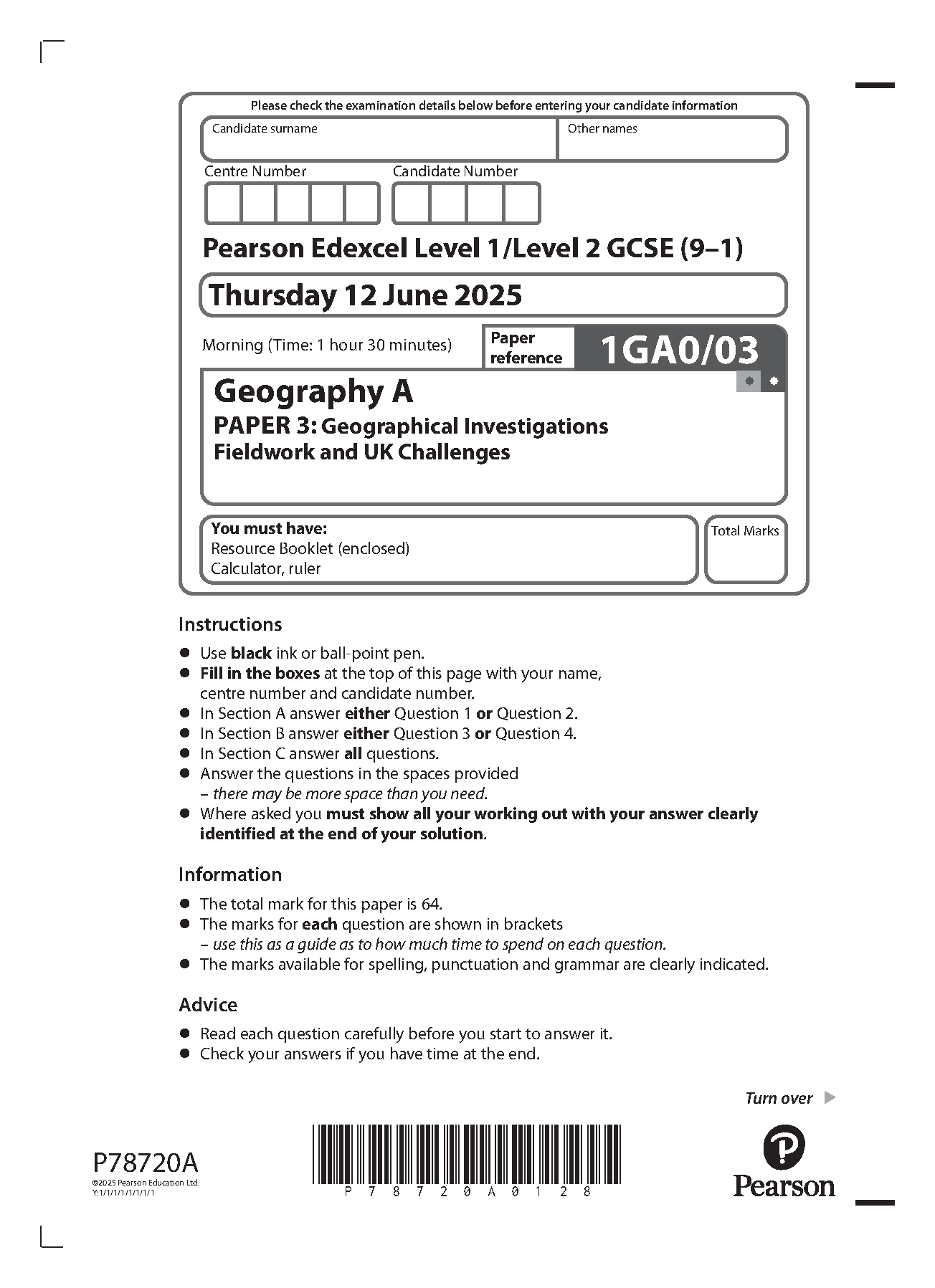

2025 Pearson Edexcel GCSE Geography A Paper 2 and Mark Scheme Combined (1GA0/02: The Human Environment)
4.2
2025 Pearson Edexcel GCSE Geography A Paper 2 and Mark Scheme Combined (1GA0/02: The Human Environment)
View example
Details
Comments
Reviews

2025 Pearson Edexcel GCSE Geography A Paper 2 and Mark Scheme Combined (1GA0/02: The Human Environment)

🌍 Paper 2: Overview & Content

  • Paper code: 1GA0/02. 

  • Title: The Human Environment. 

  • Duration: 1 hour 30 minutes. 

  • Total marks: 94 raw marks — this includes up to 4 marks for spelling, punctuation, grammar and use of specialist terminology (SPaG / specialist terms). 

  • Qualification weighting: The paper accounts for 37.5% of the total GCSE Geography A qualification. 

📚 What the Paper Covers — Topics / Sections

According to the specification, Paper 2 covers three broad topics:

Topic / Section Content / Focus
Topic 4: Changing cities Urbanisation, city growth, urban environments — how cities change, causes and consequences of urban growth, urban processes (e.g. decentralisation, suburbanisation), urban issues and management. 
Topic 5: Global development Global patterns of development and inequality, differences between more-developed and less-developed countries, measures of development (e.g. HDI, GNI), factors influencing development, effects of globalisation and trade, challenges & strategies to reduce global inequalities. 
Topic 6: Resource management Management of resources (natural, energy, water, food etc.) — but the exam requires you to choose one of the subtopics: Energy resource management or Water resource management.
  • Students must answer all questions from Section A (Changing cities) and Section B (Global development)

  • For Section C (Resource management) — students answer one of the two optional questions (either energy or water). 

✏️ Question Types & Skills Assessed

The Human Environment paper uses a variety of question formats: 

  • Multiple‑choice / multiple‑response questions

  • Short‑answer questions

  • Data‑response / calculation questions (e.g. interpreting graphs, charts, percentages)

  • Open‑response questions requiring explanation / description / analysis

  • Extended writing questions (8‑mark and sometimes higher) for essays / structured answers

Candidates are tested on:

  • Knowledge and understanding of human‑geography concepts (urbanisation, development, resource issues) — basic facts, definitions, global patterns/case studies.

  • Ability to interpret and analyse data (graphs, tables, statistics) — e.g. population data, urban growth trends, resource use data.

  • Application of geographical knowledge to real-world issues: causes and consequences, advantages/disadvantages, sustainability, management strategies.

  • Evaluation and reasoned argument — especially in extended writing: weighing pros/cons, evaluating strategies, suggesting solutions, considering multiple perspectives.

  • Communication: clear writing, correct terminology, structured responses; plus accuracy in spelling/grammar/terminology (SPaG marks).

✅ What This Means for Students — How to Prepare

  • Master core concepts across urban geography, global development, resources — know definitions, processes, causal relationships.

  • Learn case studies / facts and figures — real-world examples from different places (cities, countries, resource contexts), global development indicators, resource‑use data.

  • Practice data interpretation — reading graphs, charts, maps; doing basic calculations (percentages, ranges), comparing trends, explaining patterns.

  • Practice extended writing — build skills in structuring answers: introduction, explanation, analysis, evaluation, conclusion; show balanced arguments; address all command prompts.

  • Use geographical terminology correctly — using the right subject‑specific vocabulary can earn SPaG / specialist‑term marks.

  • Time management — with 94 marks over 1.5 hours, pace yourself: shorter answers first, leave enough time for longer responses; plan answers for essay‑style questions before writing.