
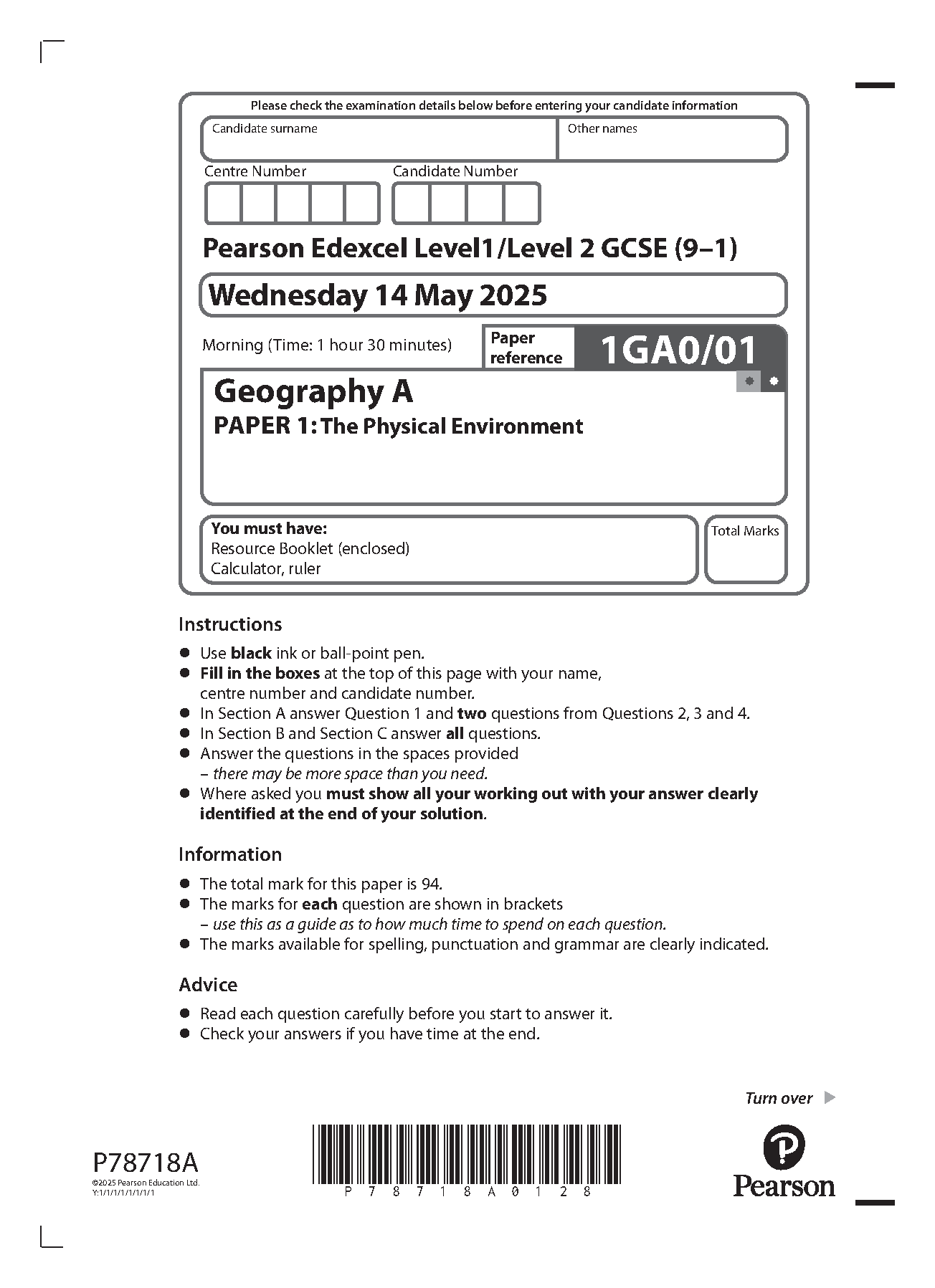

2025 Pearson Edexcel GCSE Geography A Paper 1 and Mark Scheme Combined (1GA0/01: The Physical Environment)
4.5
2025 Pearson Edexcel GCSE Geography A Paper 1 and Mark Scheme Combined (1GA0/01: The Physical Environment)
View example
Details
Comments
Reviews

2025 Pearson Edexcel GCSE Geography A Paper 1 and Mark Scheme Combined (1GA0/01: The Physical Environment)

🌍 Paper 1: The Physical Environment — Overview & What It Tests

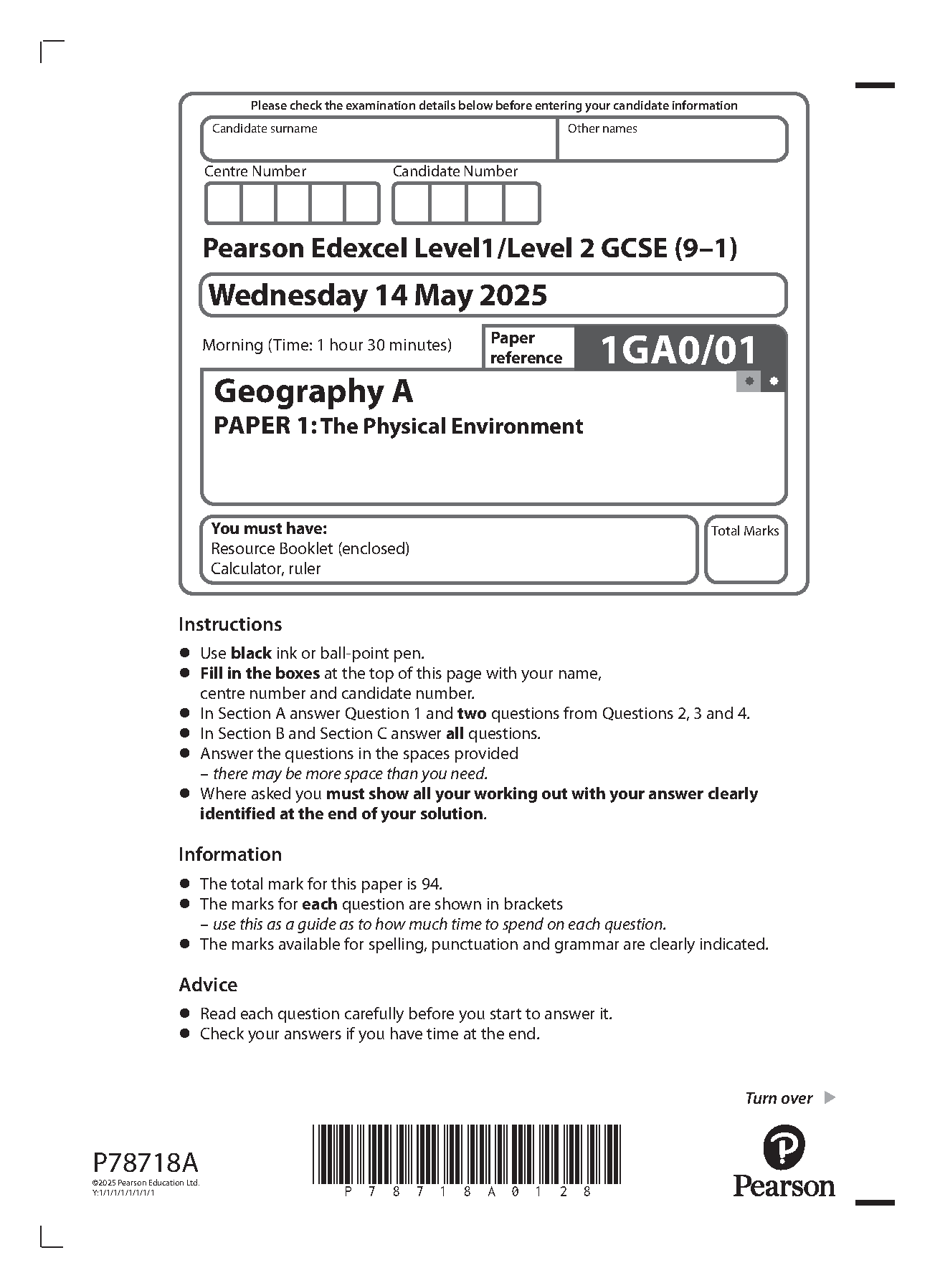
  • Paper code: 1GA0/01.

  • Purpose: Assesses students’ knowledge of physical geography — landscapes, weather/climate, ecosystems — and their ability to interpret geographical data, apply concepts, perform calculations, and provide structured answers. 

  • Duration: 1 hour 30 minutes. 

  • Total marks: 94 raw marks (this includes up to 4 marks for spelling, punctuation, grammar and use of specialist terminology — SPaG / technical terms). 

  • Qualification weighting: Paper 1 makes up 37.5% of the overall GCSE Geography A qualification. 

📚 Content Covered — Topics & Sections

Paper 1 draws on three major content areas (topics), organised into three exam sections. 

Section / Topic What’s Covered
Section A — Changing Landscapes of the UK Students study and answer on two optional landscape types from three:
• Coastal landscapes & processes
• River landscapes & processes
• Glaciated upland landscapes & processes
In the exam, candidates must answer Question 1 (on general UK physical landscape / rocks etc.) and then choose two of the optional landscape questions (i.e. two from Coastal / River / Glaciated) depending on which ones they studied. 
Section B — Weather Hazards and Climate Change This covers weather hazards, climatic patterns, climate change, and associated physical processes / hazards. Questions assess understanding of causes, effects, mitigation or adaptation, and may include data interpretation. 
Section C — Ecosystems, Biodiversity and Management Focus on ecosystems (e.g. biomes), biodiversity, environmental management and sustainability, human–environment interactions, conservation or resource management within natural environments. 

📝 Question Types & Marking / Assessment Style

  • The paper uses a mix of question types: multiple‑choice / multiple‑response, short open‑response, data‑response (maps, graphs, tables), calculations, and extended writing (e.g. 8‑mark or longer answers). 

  • Questions require a range of skills: factual recall, explanation/description, analysis, evaluation, synthesis (e.g. in manage/mitigate environment or hazard essays). 

  • The SPaG component rewards correct use of specialist geographical terminology, as well as accurate spelling, punctuation and grammar. 

✅ What This Means for Students — What to Prepare & How to Approach

  • You need to have studied two of the three optional UK landscape types (coast, river, glaciated upland) thoroughly — know processes (erosion, deposition, glaciation), landforms, cause/effect, and case studies/examples.

  • Be ready to interpret and analyse data / maps / diagrams especially in Sections B and C — e.g. climate graphs, hazard frequency charts, ecosystem distribution maps, biodiversity data.

  • Develop ability to explain, evaluate and argue: for hazards, climate change, management strategies, sustainability — not just recall.

  • Practice calculation skills (for any quantitative questions), and data‑response skills (reading graphs, tables, diagrams).

  • Use correct geographical terminology — this helps with clarity and earns extra SPaG / technical‑term marks.

  • Manage time: 94 marks over 1h30 means you’ll need good time allocation — short-answer questions fast, longer essay-style questions given enough time.