
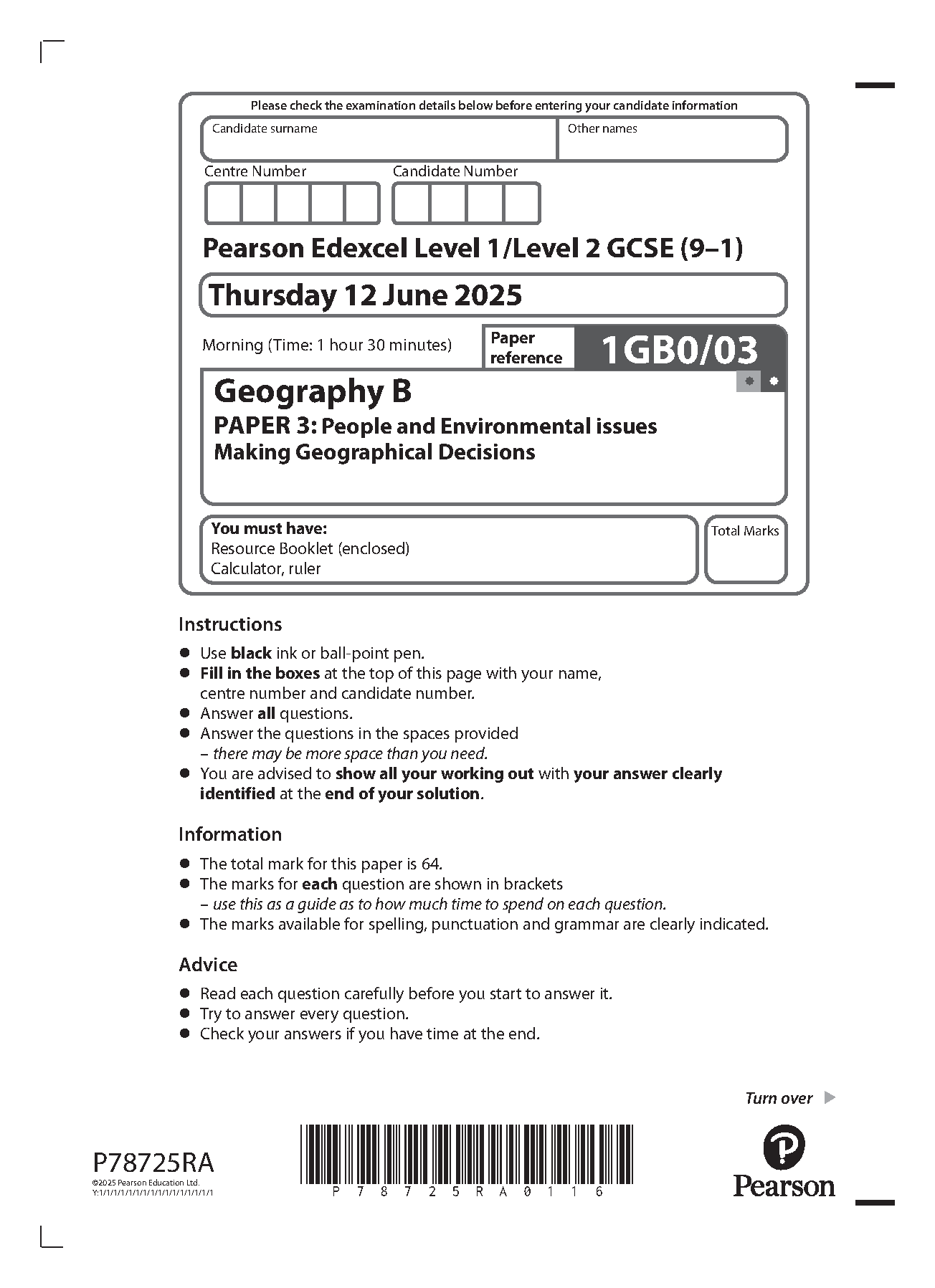
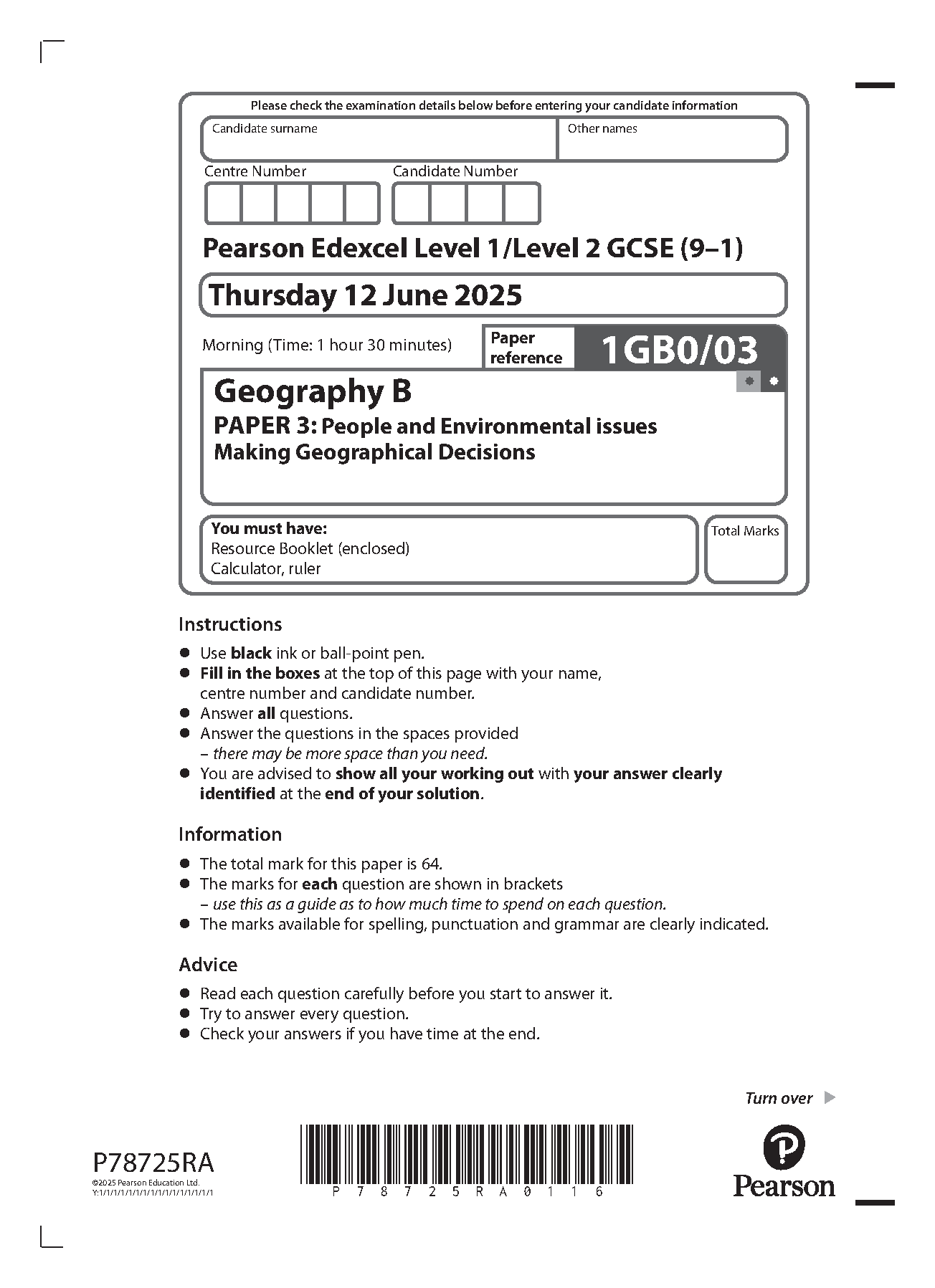

2025 Pearson Edexcel GCSE Geography B Paper 3 and Mark Scheme Combined (1GB0/03: People and Environmental issues Making Geographical Decisions)
5.0
2025 Pearson Edexcel GCSE Geography B Paper 3 and Mark Scheme Combined (1GB0/03: People and Environmental issues Making Geographical Decisions)
View example
Details
Comments
Reviews

2025 Pearson Edexcel GCSE Geography B Paper 3 and Mark Scheme Combined (1GB0/03: People and Environmental issues Making Geographical Decisions)

🌱 Paper 3: Overview & What It Covers

📚 Topics / Content Areas Covered

Paper 3 draws on three main “themes”/topics from the specification: Save My Exams+2Studocu+2

  • Topic 7 — People and the Biosphere: global biomes, resource use, population/resource debates. Save My Exams+1

  • Topic 8 — Forests under Threat: characteristics of rainforest / taiga (boreal) forest, threats to forests, management/ conservation strategies. Pearson Qualifications+1

  • Topic 9 — Consuming Energy Resources: energy types, supply & demand, environmental impact of energy use, renewable/ non-renewable resources, energy challenges and decision‑making about future energy use. Save My Exams+1

Thus the exam assesses issues at the intersection of people, environment, natural resources, and sustainability / decision-making about environmental problems. Save My Exams+2Pearson Qualifications+2


🧪 Exam Structure & Question Types

According to the specification and specimen paper: Pearson Qualifications+2Pearson Qualifications+2

The paper is divided into four sections:

  • Section A — People and the Biosphere Studocu+1

  • Section B — Forests under Threat Studocu+1

  • Section C — Consuming Energy Resources Studocu+1

  • Section D — Making a Geographical Decision — a decision-making scenario, in which students must apply knowledge, data and judgement to address a real-world environmental issue. Pearson Qualifications+2Pearson Qualifications+2

Question types include: multiple‐choice / multiple‐response, short open‑response, open‑response questions, 8‑mark extended writing (in Section C), and a 12‑mark extended writing decision question (in Section D) where quality of written communication (SPaG + use of specialist terminology) is assessed. Studocu+2Pearson Qualifications+2

The exam uses a resource booklet (with data, stimulus material) which students refer to — so questions and answers often require interpreting data / information from the booklet. Pearson Qualifications+2Docsity+2


✅ What Skills & Understanding Are Assessed

The exam tests:

  • Knowledge & understanding of human‑environment interactions: biomes, forests, energy, resource use, environmental issues. Save My Exams+1

  • Data interpretation and evaluation — interpreting data / information in the resource booklet (e.g. statistics, graphs, maps, written sources), assessing environmental issues, risks, trade‑offs. Pearson Qualifications+2Pearson Qualifications+2

  • Decision‑making and evaluative judgement — especially in Section D: constructing reasoned arguments, weighing options (economic, environmental, social), making a justified recommendation. Pearson Qualifications+2Studocu+2

  • Communication & literacy — clear writing, correct use of geography terminology, good structure, accurate grammar/spelling (SPaG). Pearson Qualifications+1


🎯 What This Means for Students — How to Prepare

  • Study thoroughly the three key themes: biomes & resources; forests under threat; energy resources — know their definitions, causes of issues, possible management/solutions.

  • Practice reading and interpreting data and sources: graphs, maps, statistics, written source excerpts (since the exam uses a resource booklet).

  • Practice extended writing and decision-making responses: particularly develop skills for 8‑mark and 12‑mark questions — structure answers with clear reasoning: define issue, discuss pros/cons, use evidence/data, conclude with justified decision.

  • Work on clear communication and geography-specific vocabulary: good terminology, accurate spelling, grammar, clear structure — these count for SPaG / specialist‑term marks.

  • Manage exam time: 64 marks over 90 minutes — shorter questions first, ensure enough time for extended writing in Section C and decision question in Section D.