
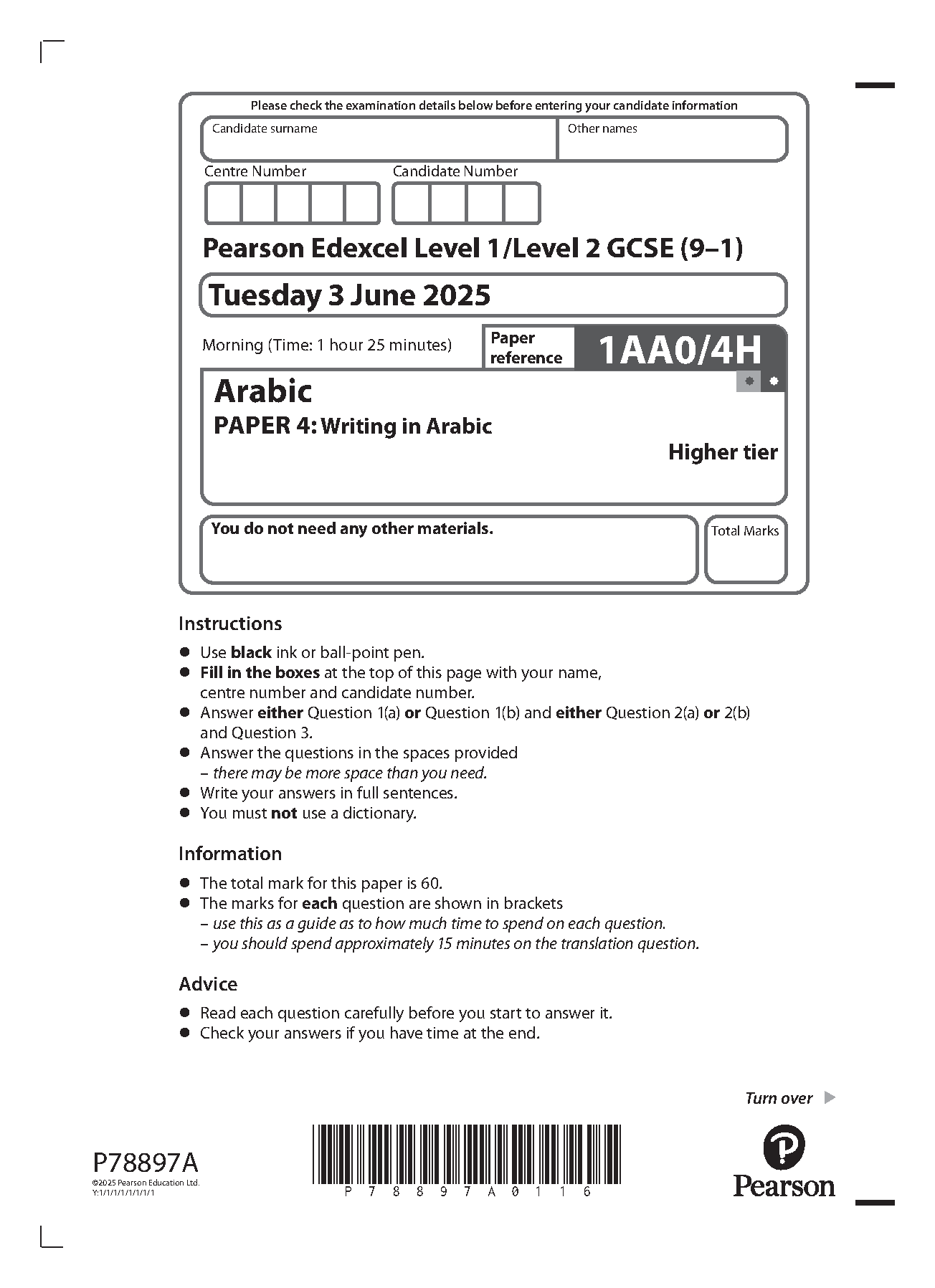

View example
2025 Pearson Edexcel GCSE Geography B Paper 2 and Mark Scheme Combined (1GB0/02: UK Geographical Issues)
Paper code: 1GB0/02.
Title: UK Geographical Issues.
Duration: 1 hour 30 minutes (for 2025) — though note: from 2026 onwards the board has announced an increase of 15 minutes for this paper.
Total marks: 94 raw marks overall. This includes marks for spelling/punctuation/grammar and use of specialist terminology (SPaG/terms).
Weight: This paper counts for 37.5% of the total Geography B GCSE qualification.
According to the specification, Paper 2 draws on three broad themes:
Topic 4 — The UK’s evolving physical landscape
This includes sub‑topics such as Coastal change and conflict and River processes and pressures. Topic 5 — The UK’s evolving human landscape
This involves studying urban change, population and settlement dynamics in UK — including a case‑study on “Dynamic UK cities.”
Topic 6 — Geographical investigations
The paper requires knowledge of one physical fieldwork investigation (relating to coasts or rivers) and one human fieldwork investigation (relating to urban or rural change) linked to Topics 4 and 5.
So the exam tests both: how physical processes shape UK landscapes (coasts, rivers), and how human activity shapes and changes the UK’s human geography (cities, rural/urban change), plus the ability to apply fieldwork‑based enquiry knowledge.
The exam is divided into three sections: Section A, Section B, and Section C.
Section A — The UK’s evolving physical landscape: questions on physical topics (coasts, rivers, landscapes).
Section B — The UK’s evolving human landscape: questions on human geography (settlement, urban/rural changes, demographic/economic aspects).
Section C — Geographical investigations (fieldwork): this section is subdivided: C1 — choose either a coastal or river‑related question (physical fieldwork); C2 — choose either a dynamic urban areas OR changing rural areas question (human fieldwork).
Question types are varied: multiple‑choice / multiple‑response, short-answer, data‑response (interpreting graphs, tables, maps), calculations, and extended writing questions (often structured, plus those requiring SPaG/terminology).
Students must answer all questions in Sections A & B, then choose one option in each sub-part of Section C (i.e. one physical, one human investigation) per the paper’s instructions. ✅ What Skills & Understanding Are Assessed
The exam assesses a broad range of geographical knowledge and skills:
Factual and conceptual knowledge about UK physical geography (coasts, rivers, landscapes) and human geography (settlement patterns, urban change, population, economy).
Fieldwork understanding — knowing how physical or human geography investigations are carried out: methods, data collection, analysis, interpretation, reliability, evaluation.
Data interpretation and analysis skills — reading and interpreting graphs, tables, maps or other resource‑based information; doing calculations where required.
Applying geographical understanding to real‑world UK contexts — explaining processes, causes and consequences, management or conflict issues (e.g. coastal change, river flooding, urban regeneration, rural change).
Extended writing and structured responses — making reasoned explanations or arguments, using appropriate geographical terminology; clear structure, accurate grammar/spelling/punctuation when required (SPaG/terms).
Decision‑making and evaluative skills — particularly in fieldwork‑related questions, where evaluation of methods and evidence reliability may be tested.
If you’re studying for 2025/2026 Geography B Paper 2, you should:
Be confident with both physical and human geography of the UK: coasts, rivers, landscape change, urban/rural change, demographic/economic trends, case‑studies of UK cities or regions.
Familiarise yourself with fieldwork investigations you have done (or have studied): what you did, what data you collected, what methods, possible limitations — because you will be asked to apply that knowledge even if the question uses novel data or context.
Practice data-handling exercises: interpreting maps, graphs, tables; making calculations; drawing conclusions from data — under timed conditions.
Practice structured and extended writing: “explain”, “assess”, “evaluate” type questions; use of terminology; clear introduction, explanation, conclusion; manage time to cover planning + writing + checking.
Review case‑studies of UK landscapes, human geography (cities, rural areas), and fieldwork; remember key examples, statistics, and relevant geographical processes.
Keep notes on common geographical terminology and definitions — these help with clarity and earn marks under SPaG/technical‑terms.
| Author | zeus999 team |
| Published | 09 Dec 2025 |
| Included files | |