

View example
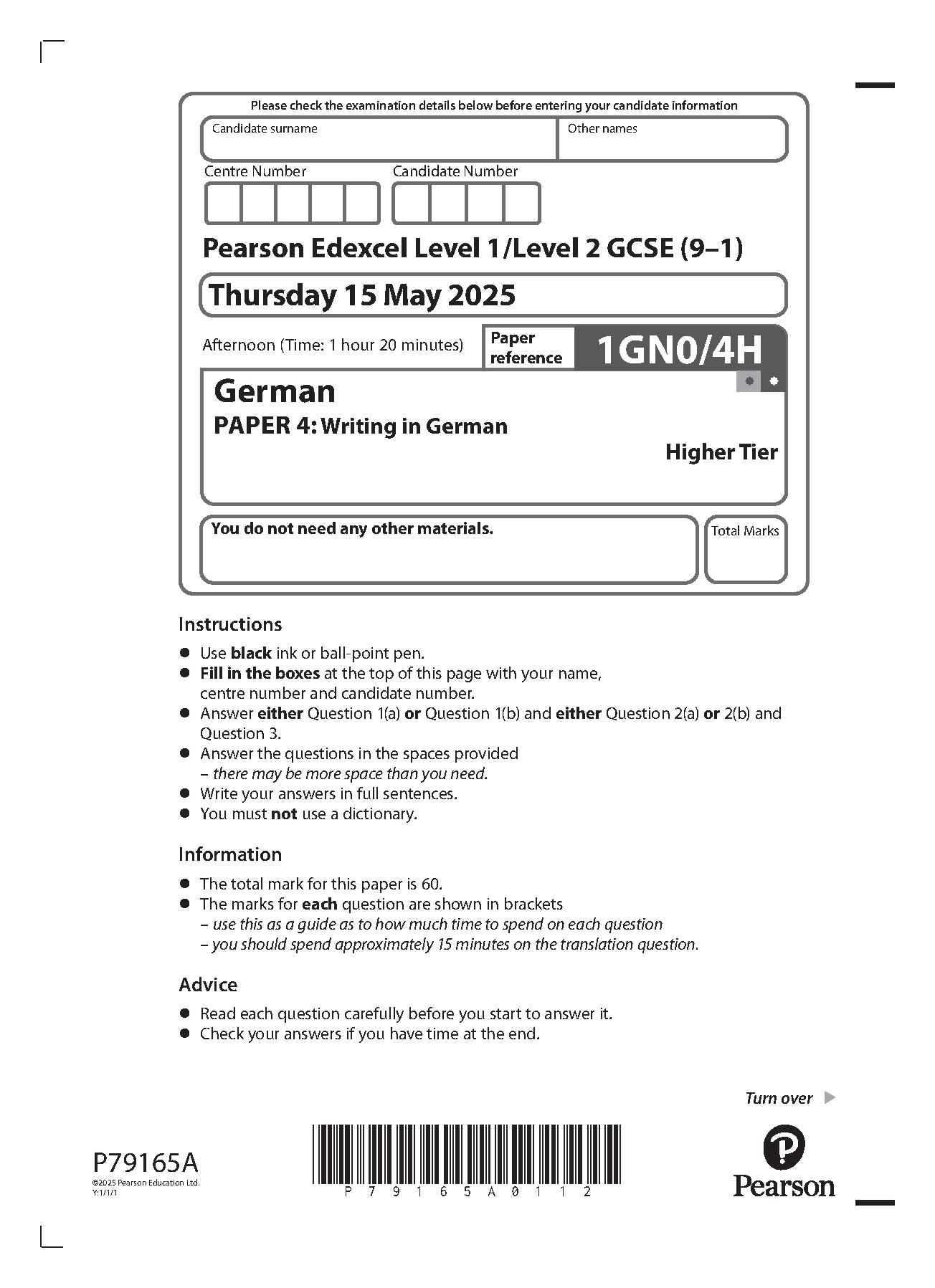
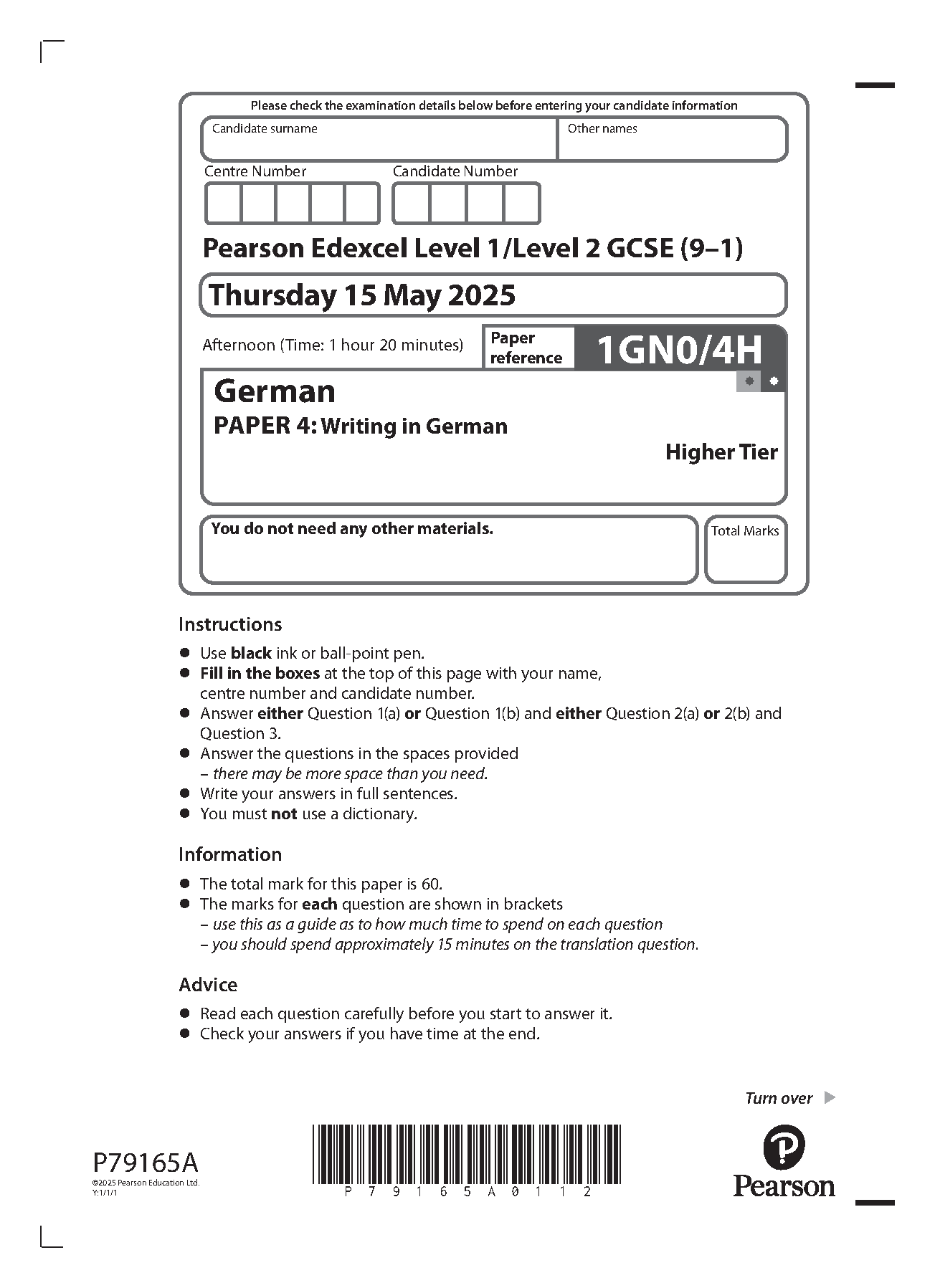
2025 Pearson Edexcel GCSE German Paper 4H and Mark Scheme Combined (1GN0/4H: Writing in German Higher Tier)
Paper code: 1GN0/4H
Title: Writing in German (Higher Tier)
Duration: 1 hour 20 minutes.
Total marks: 60 marks.
Weight: 25% of the total GCSE German qualification.
Purpose: To assess ability to communicate in written German for different purposes and audiences — e.g. informal/formal writing, expressing opinions, describing situations, translating English into German — demonstrating vocabulary, grammar, structure, and appropriateness of register. No dictionaries allowed during the exam.
Candidates must answer:
Question 1 — informal writing task: one of two choices. Question 2 — formal writing task: one of two choices.
Question 3 — translation task: translate a short passage from English into German.
| Question | Task | Suggested / expected length |
|---|---|---|
| Q1 (informal) | Write in German — informal context (e.g. message, email to friend) | ~ 80–90 words |
| Q2 (formal) | Write in German — formal context (e.g. letter, article, report) | ~ 130–150 words |
| Q3 (translation) | Translate a short English passage into German | — (exam guidance suggests ~15 minutes) |
The instructions make clear which sub‑questions (a or b) to attempt for Q1 and Q2; and Q3 is compulsory.
According to the official mark scheme for 1GN0/4H Writing:
Communication & Content: You must fulfil the task requirements (bullet‑points or prompts), produce relevant content, respond appropriately to audience/context (formal vs informal), and complete required items/points for full credit.
Mark allocations reflect the relative weighting of these skills: it is possible to lose marks for weak grammar/vocabulary even if meaning is largely clear, especially in longer writing tasks.
To do well in Paper 4H you should:
Be comfortable writing both informal and formal texts in German; know conventions (e.g. salutations, register, structure).
Practice writing longer texts (~130–150 words) under timed conditions, covering a variety of topics and prompts (opinions, experiences, future plans, social issues, etc.).
Build a strong German grammar & vocabulary base: tenses, varied sentence structures, connectors, correct spelling/punctuation, and avoid repetition.
Practice translation from English → German regularly: work on accurate meaning transfer, appropriate vocabulary and idiom, not just literal translation.
Use the mark scheme criteria as a self‑check: after writing, re‑read and evaluate your work for task fulfilment, clarity, accuracy, and register appropriateness — this helps catch issues before submission.
| Author | Proficient Academic Tutor |
| Published | 09 Dec 2025 |
| Included files | |