

View example
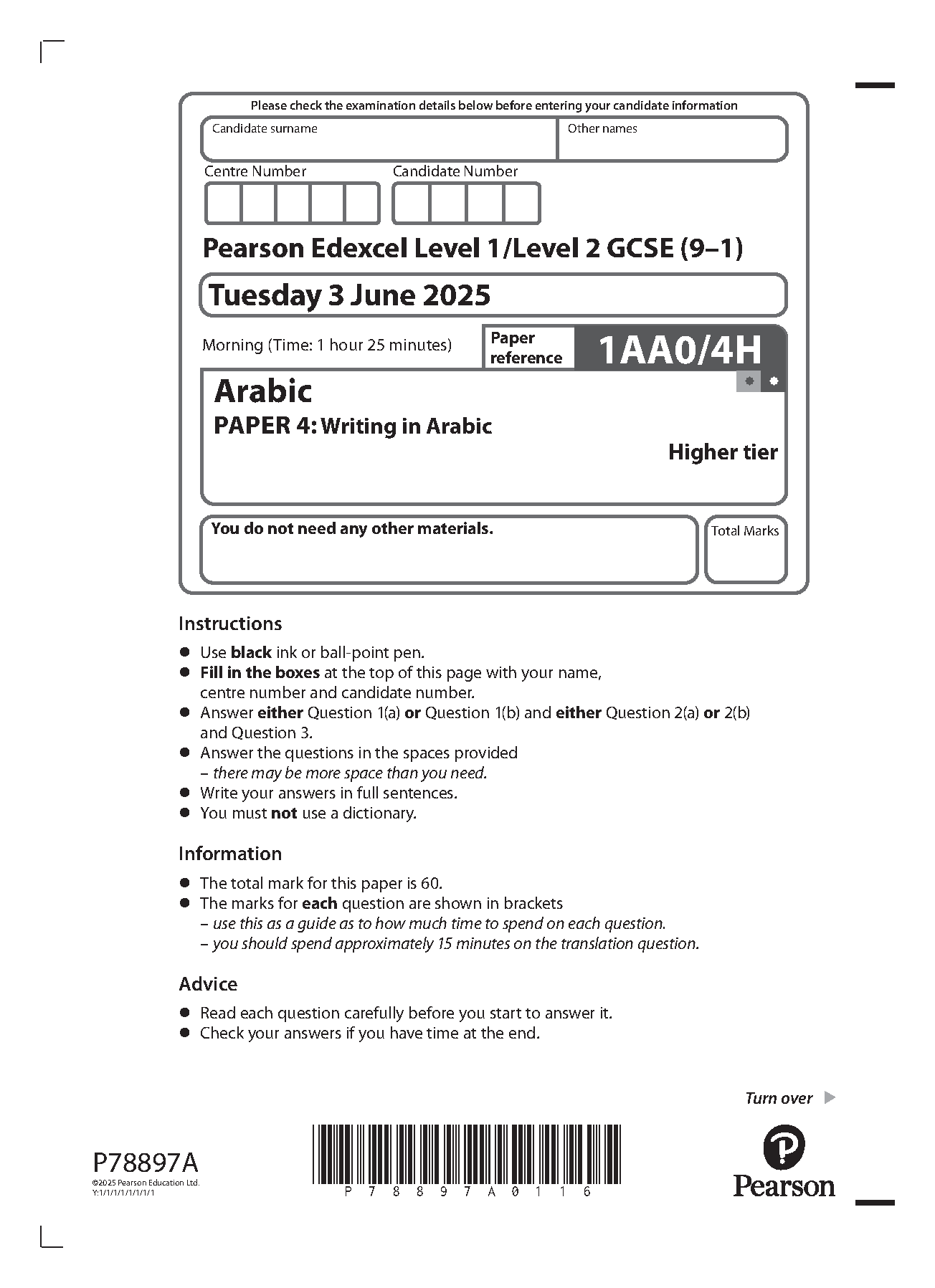
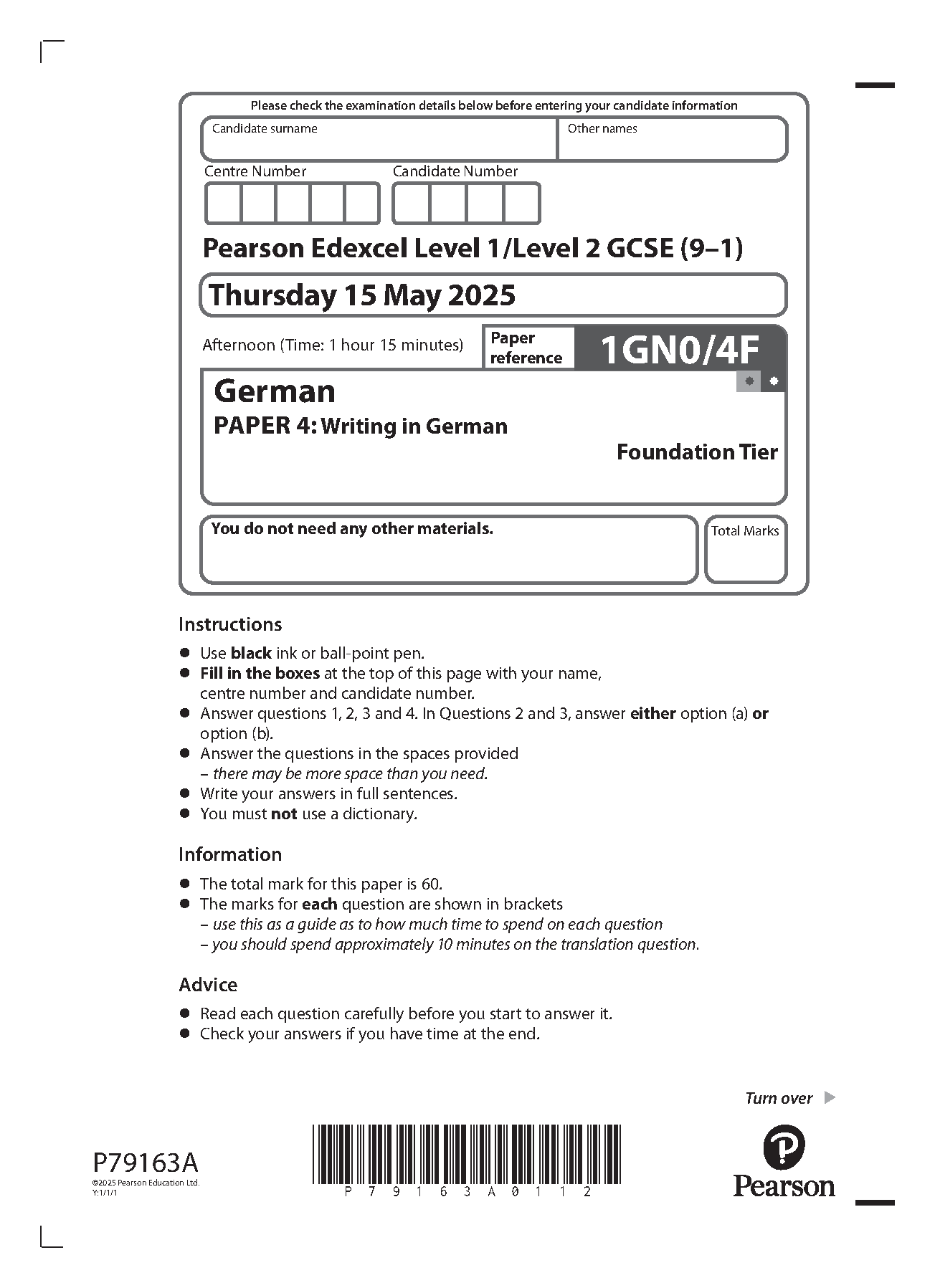
Paper code: 1GN0/4F.
Title: Writing in German — Foundation Tier.
Duration: 1 hour 15 minutes.
Total marks: 60 marks (raw).
Weight: This paper contributes 25% of the total GCSE German qualification.
Purpose: To assess a student’s ability to write in German for a variety of purposes — describing pictures, writing formal/informal texts, translation from English → German — tests practical writing skills, vocabulary, grammar, register.
Rules: No dictionary allowed. Answers must be in German. Write in full sentences.
For 1GN0/4F (Writing Foundation Tier), students must answer all four questions.
| Question | Task Type / Description | Marks |
|---|---|---|
| Q1 | Picture‑based task — write sentences / short description in German about a picture. | 8 marks |
| Q2 | Formal-context open‑response writing — student chooses one of two tasks (formal letter, note, etc.) to answer. | 14 marks |
| Q3 | Informal-context open‑response writing — choose one of two tasks (informal message/email, personal writing) in German. | 18 marks |
| Q4 | Translation: English → German (short passage) — write the provided English text in German. | 10 marks |
Total: 8 + 14 + 18 + 10 = 50 marks (some sources report 60 raw marks overall — the specification notes 50 marks for writing, but the paper itself is 60; external factors such as scaling may apply)
The paper uses a “mixed‑task” approach, covering picture description, formal writing, informal writing, and translation — reflecting real‑world language use and testing breadth of writing skills.
When marking Paper 4F, examiners are looking at:
Task fulfilment / content relevance: whether you have answered what the question asks — addressed bullet‑points/prompts, responded to formal vs informal context correctly, included required content. (Picture‑description covers items seen, writing tasks cover the required points.)
Language accuracy and range: correct grammar, spelling, punctuation; appropriate German vocabulary; variety of sentence structures. Mistakes may lose marks depending on severity/frequency.
Register and appropriateness: using suitable tone for formal or informal tasks (e.g. correct salutations, formality, register).
Translation accuracy: for Q4, how well the meaning of the original English passage is conveyed in German — correct grammar, syntax, vocabulary, clarity.
Because the writing paper is foundation tier, the emphasis is on basic but correct communication — clarity and correctness rather than advanced/complex language.
Practice writing short and medium-length texts: picture descriptions, informal messages, formal letters/notes.
Build your German grammar and vocabulary: common verbs, tenses, common thematic vocabulary (daily life, hobbies, school, travel, etc.).
Practice translation. You should be comfortable converting simple English sentences into correct German — check grammar and word‑order carefully.
Familiarise yourself with conventions of formal vs informal writing in German (e.g. how to greet/close letters or messages, register differences).
Manage time: total 1h15 — don’t spend too long on one question, leave time to check work, especially translation.
| Author | Proficient Academic Tutor |
| Published | 09 Dec 2025 |
| Included files | |